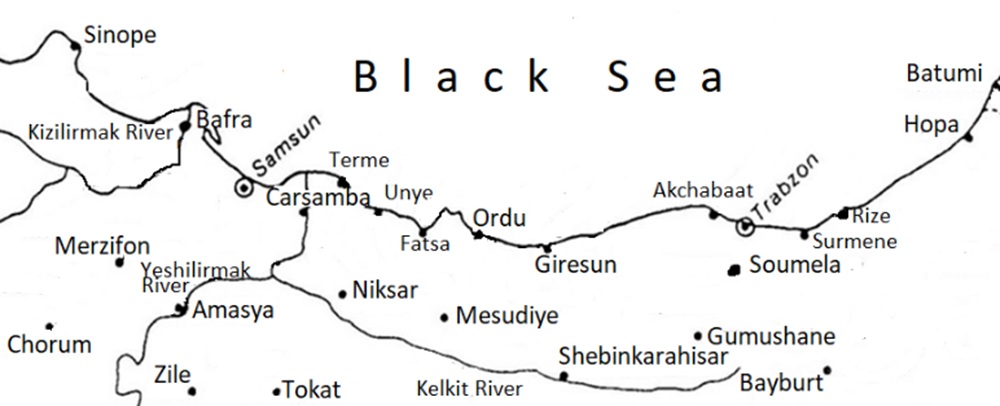
Fig. 1: North-east Türkiye (290 km Samsun to Trabzon)
Sam Topalidis (2026)
(Pontic Historian and Ethnologist)
The Greek word Pontos stands for ‘the sea’. Over time, Greek Pontos (Latin Pontus) became associated with the north-east corner of Anatolia that borders the Black Sea (Fig. 1). The Pontic Alps stretch over 700 km and less than 100 km inland from the southern Black Sea in Anatolia. The eastern area rises to 4,000 m elevation and is also considerably wetter with 2,400 mm annual precipitation, compared to the west.
Pontos is one of the most strikingly distinct regions of Anatolia. Geography, climate, economy and settlement made Pontos a maritime enclave. The boundaries of Pontos run for around 550 km (straight line distance) from Sinope in the west to the mouth of the modern Çoruh River to the east of Hopa. The Pontic Alps hem this strip to the Black Sea. Sinope was the centre of activity of the Black Sea. The Akampsis (Çoruh) River marks one of the oldest and most stable divisions in the world, between Byzantium and Persia, the Ottoman and Russian empires and today, Türkiye and Georgia.
The Pontic Alps rise gently south of Sinope, where they are broken by the Kizilirmak and Yeşilirmak Rivers which allow access to inner Pontos along the modern Kelkit valley (Fig. 1). South of Trabzon, a pass through the Pontic Gates near Zigana at about 2,500 m above sea level carries the most easterly practicable land route to Persia, until the Pontic Alps reach the Kaçkar Dağ at almost 4,000 m, about 70 km from the eastern border with Georgia. The Pontic Alps offer extensive summer pastures to nomads from the interior and people from coastal Pontos, a region streaked by steep, wooded and densely populated valleys, each with its own tartan.
Steeped in history, these valleys connect to a chain of classical Greek colonies along the coast founded from the 7th century BC, when Greeks from Miletos on the west coast of Anatolia played a leading hand in colonising the Black Sea littoral. In Pontos, Greeks encountered natives that Jason and the Argonauts found, represented in fable and fact by peoples such as Amazons to the west and the native Mossynoikoi to the east.
After the death of Alexander the Great in 323 BC, his empire broke into several entities. One of the minor entities was the Pontic empire of the Mithradates (c.302–63 BC), who were of Persian descent. This kingdom reached its peak under Mithradates VI (died in 63 BC). This empire was finally defeated by the Romans and in the 4th century AD, Pontos became part of the Byzantine (Eastern Roman) empire of Constantinople.
Perhaps the most persistent of local identities is Chaldia, a basin on the southern side of the Pontic Gates around modern Gümüşhane. Chaldia was a Byzantine military province from the 9th century and a surviving Orthodox metropolitan bishopric thereafter. Pontos is surrounded by less well-defined boundaries: Paphlagonia to the west, Cappadocia to the south and Armenia to the east.
In the 11th century, when the Seljuk Turks invaded Anatolia from the east, the Greek language in Pontos became more isolated from other Greek speaking areas. This isolation would explain the preservation of many medieval characteristics in the Romeyka Greek dialect in some current Pontic centres in Türkiye and Pontic Greek1 spoken in Greece that have disappeared from demotic Greek. Romeyka Greek is basically unintelligible from the demotic Greek of Greece.
In 1185, the Byzantine emperor Andronikos I Komnenos and his eldest son Manuel were murdered. Later, in 1204, the Latins of the Fourth Crusade conquered Constantinople. Just before Constantinople fell, Manuel’s two sons, Alexios and David left for Georgia. From there, with a contingent provided by their aunt, queen Thamar, they occupied Trabzon and controlled up to Sinope to the west. In 1214, the Seljuk Turks occupied Sinope and the small ‘empire of Trebizond’ (1204–1461) was reduced to the east with its capital at Trabzon. It became an independent state separate from Constantinople. Its wealth and influence outstripped its size and population. The important transit trade via land and sea was very profitable due to the collected taxes on goods passing through Trabzon. The Komnenoi emperors of Trebizond were Greek by language, Eastern Roman by culture and Orthodox Christian by faith. In 1461, Trabzon surrendered to the Ottoman sultan Mehmed II.
After over 550 years of Ottoman/Turkish control in Pontos and with the defeat of Greece in the Greco-Turkish War (1919–1922), Orthodox Christians in Anatolia (who had survived the genocide)] were forced out of Ottoman lands for Greece and Muslims were moved out of Greek lands to Turkey (which was formalised under the Lausanne Convention signed in January 19232). This Convention effectively removed Greeks from Turkish territory to Greece.
Acknowledgements
I warmly thank Michael Bennett and Russell McCaskie for their comments to an earlier draft.
1. Once Pontic Greeks who spoke Romeyka Greek came to Greece, their speech absorbed terms from demotic Greek and their dialect is called Pontic Greek. See:
https://pontosworld.com/index.php/history/sam-topalidis/892-romeyka-an-endangered-greek-dialect
2. Exceptions were Greeks who had settled in Constantinople before 30 October1918. The exclusion of Orthodox Greeks from the islands of Imbros and Tenedos was specified in the wider Treaty of Lausanne (signed in July 2023).
References
Bryer A (1991) ‘The Pontic Greeks before the diaspora’, Journal of Refugee Studies, 4(4):315–334.
Bryer AAM (2010) ‘Pontus’, Encyclopedia of ancient Greece (Wilson N (ed) (2010):599, Routledge, New York, USA.
Hirschon R (ed) (2003) Crossing the Aegean, Berghahn Books, New York, USA.
Liddell HG and Scott R (1889) An Intermediate Greek—English Lexicon, 7th ed, Oxford University Press, Oxford, England.
Mackridge P (1987) ‘Greek-speaking Moslems of north-east Turkey: prolegomena to a study of the Ophitic sub-dialect of Pontic’, Byzantine and Modern Greek Studies, 11:115–137.
Miller W (1926) Trebizond: the last Greek empire, The MacMillan Co, London, England.
Nicol DM (1996) The Byzantine lady: ten portraits, 1250–1500, Cambridge University Press, Cambridge, England.
Roller DW (2020) Empire of the Black Sea: the rise and fall of the Mithridatic world, Oxford University Press, New York, USA.
Thonemann P (2016) The Hellenistic age, Oxford University Press, Oxford, England.